Last Updated: December 26, 2025 | Reading Time: 45 minutes | Expert Level: Advanced
📊 Quick Summary: What’s New in Meta Ads for 2026
The Facebook/Meta ads updates for 2026 represent the most significant transformation in digital advertising history. If you’re still running campaigns the way you did in 2023, you’re already behind. This comprehensive guide reveals how Meta’s new Andromeda algorithm, Generative AI capabilities, and regulatory challenges are reshaping the entire advertising landscape.
🎯 Key Takeaways:
- ✅ Manual targeting is officially obsolete—replaced by algorithmic autonomy
- ✅ Creative diversity now matters more than bid strategies
- ✅ European advertisers face fundamentally different rules than US marketers
- ✅ AI-powered creative generation is no longer optional for competitive brands
- ✅ Server-side tracking via CAPI is the only reliable measurement method
📱 Introduction: Why the Facebook/Meta Ads Updates for 2026 Change Everything
The digital advertising landscape of 2026 bears little resemblance to the structure that defined the early 2020s. We have witnessed the final transition from an era of “media buying”—characterized by manual targeting, bid hacking, and granular audience segmentation—to an era of “algorithmic autonomy.” 🤖
Meta (formerly Facebook) has successfully re-engineered its advertising stack around two proprietary technologies: the Andromeda retrieval algorithm and the Generative Ads Model (GEM). Together, these systems have rendered traditional campaign management obsolete, replacing it with a paradigm where the primary lever for performance is no longer the media setting, but the creative input.
🔄 The Survival Necessity Behind These Facebook/Meta Ads Updates
This transformation was not merely a feature update; it was a survival necessity. Following the signal loss precipitated by Apple’s App Tracking Transparency (ATT) and the subsequent deprecation of third-party cookies, Meta was forced to rebuild its ad engine from the ground up.
The result is an infrastructure that does not rely on tracking who a user is via cookies, but rather predicts what a user will do via massive-scale behavioral modeling. By 2026, this infrastructure has matured. The Meta Lattice prediction architecture now aggregates signals across Facebook, Instagram, WhatsApp, and Threads to form a unified, probabilistic understanding of user intent that transcends individual sessions or devices.
💡 Expert Insight: The most successful advertisers in 2026 are those who have shifted from being “media buyers” to “creative engineers.” The technical barrier to entry has vanished, but the strategic barrier has risen exponentially.
🌍 The Geopolitical Reality: The “Splinternet” Effect
However, this technological leap has occurred against a backdrop of geopolitical and regulatory fracture. The global advertising market is no longer a monolith. The European Union’s rigorous enforcement of the Digital Markets Act (DMA) has forced a bifurcation of the internet, creating a “Splinternet” where advertising strategies in Europe must fundamentally differ from those in North America and Asia.
While US advertisers lean into hyper-personalized, AI-driven behavioral targeting, their EU counterparts navigate a “Pay or Consent” reality that prioritizes contextual signals over historical profiling. 🇪🇺
🎯 What This Guide Covers
This comprehensive analysis of the Facebook/Meta ads updates for 2026 provides:
✔️ Technical deep-dives into Andromeda and Meta Lattice algorithms
✔️ Strategic frameworks for creative production and campaign structure
✔️ Regulatory guidance for navigating the global compliance landscape
✔️ Platform-specific tactics for Threads, Ray-Ban smart glasses, and more
✔️ Measurement solutions in a post-cookie world
✔️ Industry benchmarks and cost projections for budget planning
Whether you’re a digital marketing executive, data scientist, or brand strategist, this guide will equip you with the knowledge to navigate a world where the algorithm is both the pilot and the engine. 🎓
🧠 Section 1: The Algorithmic Core—Understanding the Andromeda Revolution
To master the Facebook/Meta ads updates for 2026, you must first understand the machine that decides who sees your ad. The shift from the legacy retrieval system to the Andromeda architecture represents the most significant backend overhaul in the platform’s history. This is not a change in the user interface; it is a change in the physics of the ad auction. ⚛️
💻 The Hardware Foundation: NVIDIA GH200 and Massive Parallelism

The capabilities of the 2026 ad stack are directly tethered to advancements in silicon. Meta’s advertising infrastructure is now powered largely by NVIDIA’s GH200 Grace Hopper Superchips. This hardware transition was critical to support the Andromeda algorithm, which requires computational density far exceeding previous generations.
🔧 Technical Specs That Matter:
The GH200 architecture allows for a unified memory space between the CPU and GPU, significantly reducing the latency involved in retrieving massive embedding tables—the mathematical representations of user interests and ad features. In practical terms, this hardware acceleration enables Andromeda to perform retrieval operations at speeds approximately 100 times faster than the systems used in 2023–2024.
⚡ The Retrieval vs. Ranking Paradigm Shift
In previous iterations of the ad auction, the “retrieval” phase (finding all eligible ads for a user) was a bottleneck. To maintain speed, the system had to filter out vast swathes of potential ads using crude heuristics before passing a small subset to the “ranking” phase (predicting the probability of a click or purchase).
Andromeda removes this bottleneck. Because it can process 10,000x more ad variants in parallel, the system no longer needs to aggressively filter ads early in the process. It can evaluate a massive pool of potential creatives for every single impression opportunity.
⚠️ Critical Implication for Advertisers: The “auction pressure” is higher than ever. Your ad is competing against a much larger pool of relevant candidates because the system is smart enough to consider edge cases that previous algorithms would have ignored.
📈 The Long Tail Advantage: This architecture favors the “long tail” of creative inventory. An ad that might seem niche is more likely to find its specific audience because Andromeda can afford to evaluate it against specific user micro-signals without slowing down the feed.
🔮 Meta Lattice: The Predictive Brain
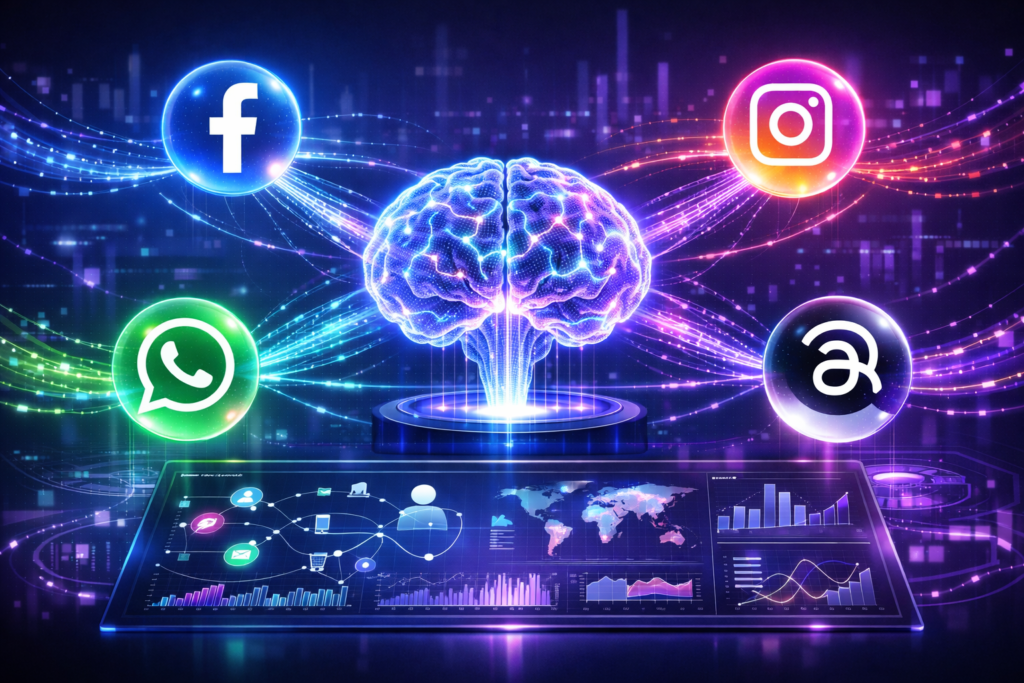
While Andromeda handles the retrieval of ads, Meta Lattice is the brain that predicts their performance. Lattice is a multi-modal prediction architecture that learns from the entirety of Meta’s ecosystem. It ingests data from organic interactions on Instagram Reels, message sentiment in business chats on WhatsApp (where permitted), and topical engagement on Threads.
Lattice operates on the principle of Cross-Signal Learning. In the past, ad ranking models were often segmented—one model for video views, another for clicks, another for purchases. Lattice unifies these into a single, massive model that understands the relationship between different actions.
🎯 Two Revolutionary Capabilities:
- Causal Inference: By 2026, Lattice has moved beyond simple correlation. It attempts to model incrementality—predicting not just if a user will buy, but if the ad causes the buy. This shift was necessitated by the need to prove value to advertisers skeptical of “last-click” attribution in a privacy-first world.
- Signal Resilience: Lattice is designed to be robust against signal loss. Even if a user’s specific purchase data is obfuscated by iOS protections, Lattice infers conversion probability based on “cohort behavior”—how users like this person tend to behave—with a degree of accuracy that rivals direct tracking.
🚨 The “Creative Similarity” Penalty: Why Duplicate Ads Kill Your Performance
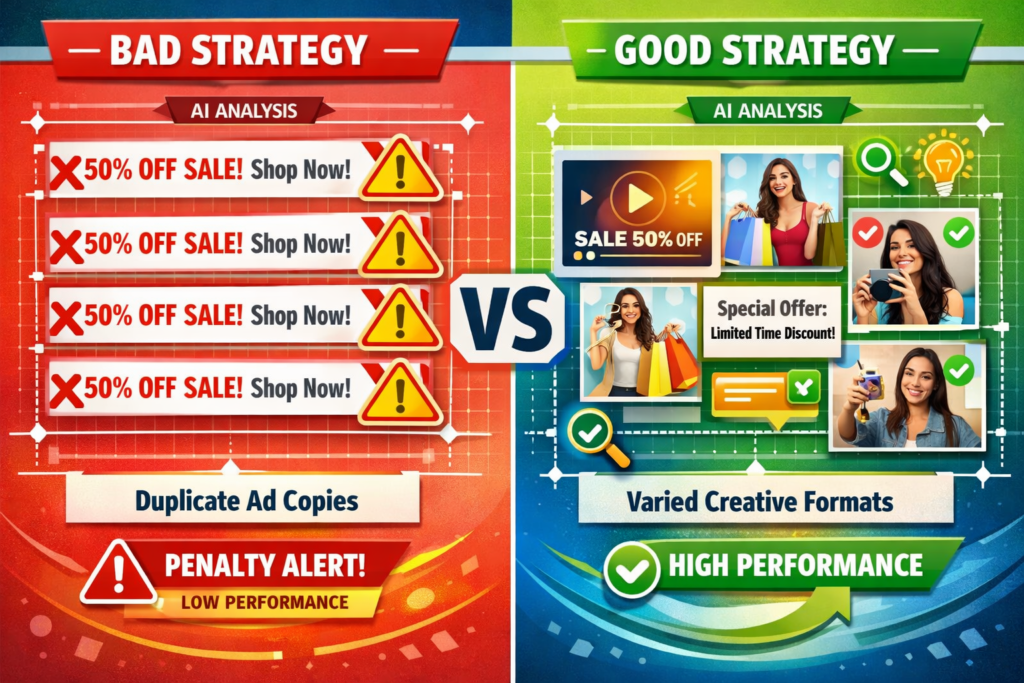
Perhaps the most critical, yet least understood, component of the Facebook/Meta ads updates for 2026 is the Creative Similarity Score. As the algorithm evolved to handle thousands of variations, engineers discovered that advertisers were “spamming” the system with near-identical ads (e.g., the same video with slightly different hooks or background colors) to game the auction.
To combat this, Meta introduced a penalty mechanism within Andromeda:
🔍 How It Works:
- Visual Semantic Analysis: The system uses computer vision to analyze the actual content of the ad—the pixels, the text overlays, the pacing of the video.
- The Penalty: If an ad account launches 50 ads that share a high “Similarity Score,” Andromeda groups them. Instead of treating them as 50 chances to win an auction, it treats them as a single candidate. Worse, if the user experience is deemed repetitive, the system applies a CPMr (Cost Per Mille reach) surcharge—effectively a tax on creative laziness.
💰 Pro Tip: The era of “iterative testing” (changing one button color) is dead. The algorithm rewards “True Variation”—radically different concepts that appeal to different psychological triggers.
✅ Strategic Consequence: An advertiser must now run a portfolio that includes a polished studio video, a raw UGC (User Generated Content) clip, a static meme, and a text-only card. This diversity maximizes the “surface area” of the account, allowing Andromeda to match the right format to the right user mindset.
🎨 Section 2: The Creative Revolution—Generative AI and the New Production Paradigm

By 2026, the bottleneck in advertising is no longer media buying; it is creative production. To address this, Meta has integrated Generative AI directly into the ad infrastructure, moving from “Assisted Creation” to “Autonomous Generation.” This represents one of the most transformative Facebook/Meta ads updates for 2026. 🎬
🤖 Meta GEM (Generative Ads Model): Your AI Creative Partner
At the heart of this shift is GEM (Generative Ads Model). Unlike generic Large Language Models like GPT-4, GEM is a domain-specific foundation model trained specifically on performance advertising data. It understands not just how to construct a sentence or an image, but how to construct a converting ad.
📝 How GEM Works:
GEM operates on a “Goal-Based” input system. Advanced advertisers in 2026 can utilize a workflow where they provide:
- Product URL: The source of truth for features and benefits
- Objective: e.g., “Acquire new customers for a winter sale”
- Budget & Constraints: Financial limits and brand safety guardrails
From these inputs, GEM generates the entire campaign payload:
🎯 Visual Synthesis: It generates image and video assets. Crucially, it creates variations based on predicted user preferences. It might generate a “lifestyle” image for a user who engages with influencers, and a “product-focused” image for a user who engages with reviews.
✍️ Copywriting: It drafts headlines and primary text, tailoring the tone (urgent, informative, humorous) to the specific placement and user history.
📐 Layout Optimization: It automatically composites the ad, placing the Call to Action (CTA) button and text overlays in the areas of the screen where the specific user is most likely to look.
⚙️ Advantage+ Creative: The New Default Operating System
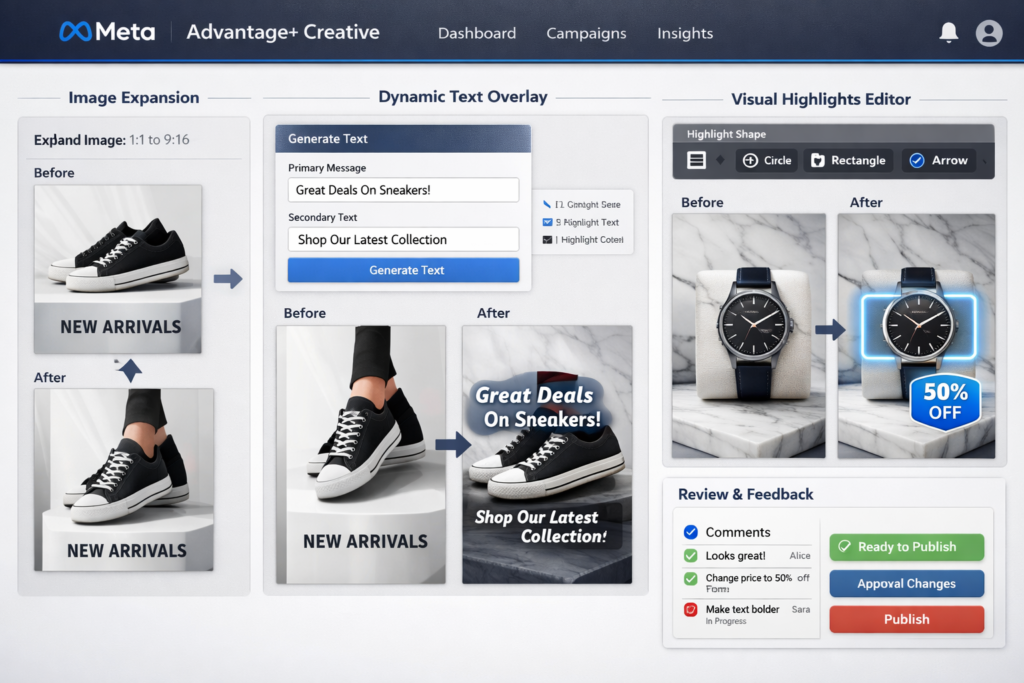
The Advantage+ Creative suite has evolved from a set of optional toggles to the default setting for most accounts. By 2026, manual creative formatting is considered an “advanced” (and often inefficient) override.
🌟 Key Features of the 2026 Suite:
1. Generative Image Expansion 📱
The system automatically expands assets to fit aspect ratios. A 1:1 square image meant for the Feed is seamlessly extended to 9:16 for Reels. The AI analyzes the border pixels and hallucinates a coherent background, effectively turning every asset into a universal placement asset.
2. Dynamic Text Overlays 🔤
Andromeda detects when a user is watching a video with the sound off (a common behavior) and automatically generates and overlays kinetic typography captions that highlight the key selling points, synced perfectly to the video pacing.
3. Visual Highlights ⏱️
For longer video assets, the AI identifies the statistical “retention peaks”—the moments where viewers are most likely to stop scrolling. It then automatically creates short-form “remix” versions of the ad that start with these high-impact moments, optimizing for the 3-second attention span of the TikTok/Reels generation.
4. Review Integration ⭐
If the business has positive reviews on its Facebook Page or website, the system can automatically pull a 5-star review and overlay it on the ad creative dynamically for users who respond well to social proof.
🧪 The “Creative Sandbox” Methodology: A Framework for Winning
With AI handling the execution, the human role has shifted to high-level strategy and “feeding the machine.” The most effective creative strategy in 2026 is the Sandbox Method.
| Stage | Action | AI Role | Human Role |
|---|---|---|---|
| 1. Ideation | Generate 5-10 distinct “Archetypes” (e.g., Founder Story, Problem/Solution, ASMR) | GEM suggests angles based on competitor data | Define the core psychological hooks and brand voice |
| 2. Testing | Launch a dedicated “Sandbox” campaign (ABO) to test these concepts against broad audiences | Andromeda distributes impressions to find the best fit | Monitor qualitative feedback (comments) and “Hook Rate” |
| 3. Analysis | After 7 days, identify winners | AI analytics tools analyze why a hook worked | Interpret the data to understand customer motivation |
| 4. Iteration | Feed the winning concepts back into GEM to generate variations | GEM produces 20 iterations of the winning concept | Approve the variations for brand safety |
🎓 Learning Point: This loop solves the volume problem. Instead of humans trying to guess which background color works, they focus on finding the concept that works, and let GEM handle the permutations.
📲 Section 3: Expanding Inventory—Threads, Wearables, and The “Post-Smartphone” Future

The “Metaverse” vision of 2021 has been tempered and refocused into a strategy of “Ambient Computing.” In 2026, ad inventory extends beyond the glowing rectangle of the phone into the peripheral vision of the user via smart glasses and the conversational interface of Threads. These platform expansions are among the most exciting Facebook/Meta ads updates for 2026. 🕶️
💬 Threads: The Mature Conversational Layer
Threads has successfully carved out a niche as the “public square” of the Meta ecosystem, distinct from the visual polish of Instagram and the social graph of Facebook. By 2026, the Threads API has reached maturity (v2+), enabling sophisticated ad placements.
📊 Ad Formats and Specifications:
1. Carousel Ads 🎠
Threads users are conditioned to scroll. Carousel ads, which allow users to swipe through multiple cards (images or videos), have proven highly effective here. The format supports 1:1 images and allows for storytelling sequences.
2. Video Integration 🎥
The API supports video ads with aspect ratios from 1.91:1 up to 9:16. However, the user experience on Threads favors the 4:5 aspect ratio. Assets taller than this are cropped and centered, meaning advertisers must design specifically for this “portrait-lite” format to avoid losing critical visual information.
3. Advantage+ Catalog Ads 🛍️
This is the killer feature for e-commerce on Threads. The system can dynamically inject a product card into the feed based on the user’s browsing history on other Meta apps. It feels less like an “ad” and more like a relevant suggestion within a text-heavy stream.
🎯 Placement Asset Customization (PAC):
A critical update in the Marketing API is Placement Asset Customization (PAC) for Threads. This allows advertisers to treat Threads as a distinct placement within a unified campaign. They can upload a specific creative asset (e.g., a text-heavy graphic or a witty one-liner image) that runs only on Threads, while running a video on Reels, all within the same Ad Set. This prevents the “lazy adaptation” problem where inappropriate Instagram creatives are forced onto Threads.
👓 Ray-Ban Meta Smart Glasses: The “Glanceable” Ad Experience
The Ray-Ban Meta Smart Glasses have become a surprise hit, validating the form factor of “smart eyewear” without full holographic AR. In 2026, the device features LCOS (Liquid Crystal on Silicon) displays capable of 5,000 nits brightness, projecting a clear Heads-Up Display (HUD) into the user’s right eye.
🎯 The Inventory: Contextual Intelligence
Advertising on this platform is extremely cautious to avoid the “Glasshole” stigma. The inventory is defined by Contextual Intelligence:
📍 Location-Based Signals: The glasses know where the user is looking. If a user gazes at a movie poster, the AI can recognize it. While overt pop-up ads are restricted, “opt-in” experiences allow users to ask “Hey Meta, get me tickets for this,” triggering a commercial transaction.
🏪 Local Discovery: For local businesses, the “Neural Band” interface allows users to perform micro-gestures (a subtle finger tap) to save a location or an offer they walk past. This connects digital impressions to physical footfall in a way smartphones never could.
🔮 Future Watch: The industry is preparing for “Hypernova,” the code name for the next generation of glasses expected in 2027. The 2026 advertising strategy is a testing ground for “Audio-First” branding, ensuring that brands have a “sonic identity” that works when a screen isn’t visible.
🥽 Quest and Horizon OS: The VR Pivot
The VR strategy has pivoted from a consumer “Metaverse” to a gaming and utility focus. The Quest 4, running on Android 14, has unified the development pipeline.
🎮 In-Game Ads: The primary inventory here remains rewarded video and billboard placements within free-to-play games on the Horizon OS.
💡 Budget Shift: Notably, Meta has shifted significant internal funding from “Metaverse” software development toward AI Wearables (Glasses), signaling to advertisers that the “spatial” future is likely to be see-through (AR) rather than occluded (VR).
🌍 Section 4: The “Splinternet”—Navigating Regulatory Divergence
In 2026, there is no “Global” advertising strategy. There is a “Western” strategy (highly regulated) and a “Rest of World” strategy. The divergence between the European Union and the United States has created two distinct operating environments—making this one of the most complex aspects of the Facebook/Meta ads updates for 2026. ⚖️
🇪🇺 The EU “Pay or Consent” Model
The Digital Markets Act (DMA) has forced Meta to radically alter its business model in Europe. After years of legal wrangling, Meta implemented a “Pay or Consent” model in January 2026.
📋 The Three Tiers of EU Access:
1. Consent (Personalized) ✅
The user agrees to full tracking. They receive the full power of the Lattice algorithm and behavioral targeting.
2. Pay (Subscription) 💳
The user pays a monthly fee for an ad-free experience. (Adoption remains niche but significant among affluent demographics).
3. Less Personalized Ads (The New Default) 🎯
This is the critical shift. Users who refuse to pay and refuse full consent are placed in this tier. Here, ads are targeted based only on Contextual Signals (what they are viewing right now) and broad location data (city-level). Historical data, third-party website activity, and long-term behavioral profiling are blocked.
💼 Impact on Strategy:
This tier breaks the “feedback loop” that modern performance marketing relies on.
📉 ROAS Degradation: For users in the “Less Personalized” tier, conversion rates are significantly lower because the ads are less relevant.
🎯 Contextual Resurgence: Advertisers targeting the EU must revive “Contextual Targeting” strategies. Selling running shoes? You can no longer just target “People interested in running.” You must rely on the algorithm placing your ad next to content about running.
❓ Measurement Black Hole: Attribution for this tier is severely limited, forcing a reliance on Media Mix Modeling (MMM) rather than direct attribution.
🇺🇸 US Privacy: The State Law Patchwork

While the US lacks a federal GDPR, the cumulative weight of state laws has created a de facto regulation. In 2026, new comprehensive privacy laws in Indiana, Kentucky, and Rhode Island came into effect.
🔒 Sensitive Data: These laws explicitly protect “sensitive data,” which now often includes Precise Geolocation and Neural Data (anticipating the wristband inputs of the Ray-Ban glasses).
🚫 Universal Opt-Out Mechanisms (UOOM): Laws in Oregon and elsewhere now mandate that platforms honor browser-based “Do Not Sell” signals (like Global Privacy Control). If a user’s browser sends this signal, Meta must automatically suppress that user from retargeting lists built on third-party data.
⚠️ Critical Business Decision: Because it is technically difficult to treat an Indiana user different from a Kentucky user in real-time, most national brands effectively apply the strictest state standard (usually California or Oregon) to their entire US audience to minimize legal risk. This effectively ends the era of unrestricted third-party data usage in the US.
📊 Section 5: Measurement, Attribution, and Data Infrastructure
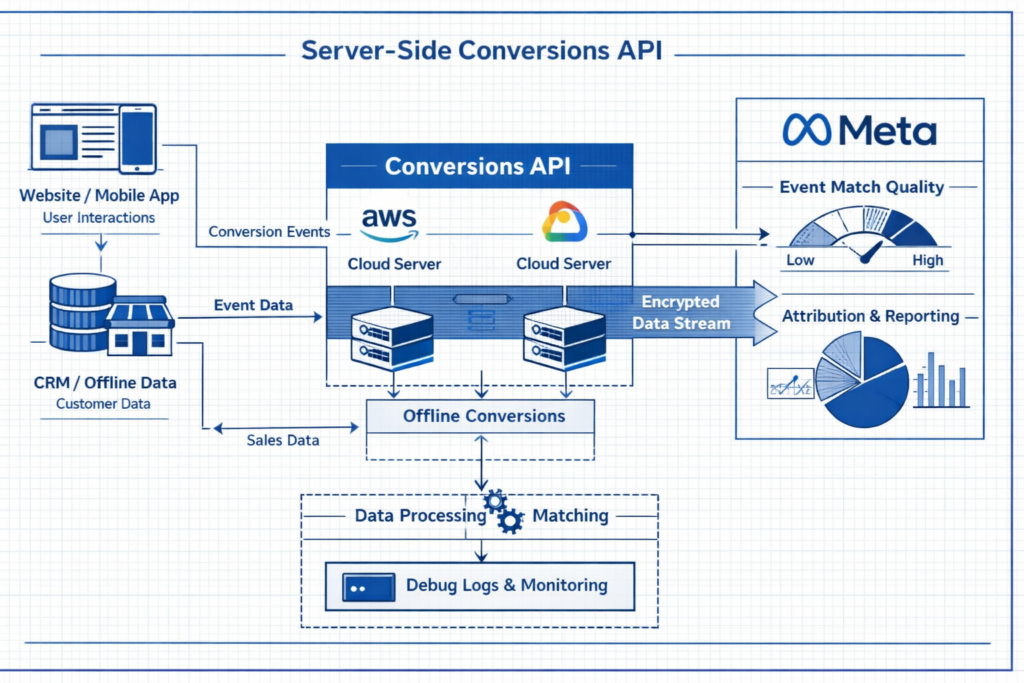
With the loss of client-side visibility (cookies), the entire measurement stack has migrated to the server. The Conversions API (CAPI) is the backbone of 2026 measurement—making it essential knowledge for anyone implementing the Facebook/Meta ads updates for 2026. 🔧
🔌 CAPI: The Only Source of Truth
Client-side pixels are now considered a “fallback” mechanism. Browser interventions and the stripping of URL parameters (Link Decoration) mean that pixel-based tracking misses 15-30% of conversions.
⚙️ CAPI Gateway: For enterprise advertisers, the CAPI Gateway allows for the management of multiple pixels and datasets through a centralized server container, often hosted on AWS or Google Cloud.
🏪 Offline Unification: The dedicated “Offline Conversions API” was deprecated in 2025. Now, offline events (in-store sales, call center closes) are sent through the main CAPI endpoint. This is critical for Lattice, as it needs to see the “full picture” of a user’s value, not just their web activity.
📉 The Deprecation of View-Through Windows
A major blow to “vanity metrics” came with the Ads Insights API v22/v23 updates.
🔄 The Change: As of January 12, 2026, Meta deprecated the 7-day view and 28-day view attribution windows in the API.
💥 The Impact: Advertisers can no longer report on users who viewed an ad, didn’t click, but converted 2 weeks later. This makes upper-funnel campaigns (Brand Awareness) look significantly less effective in standard reports.
✅ The Workaround: This forces a shift to Incrementality Testing. Brands must run “Lift Studies” (Geo-tests) to prove that their upper-funnel spend is driving incremental revenue, even if the daily dashboard doesn’t show it.
🎯 Signal Resilience and First-Party Data
To survive signal loss, brands are hoarding First-Party Data.
📧 Advanced Matching: Advertisers are hashing email addresses and phone numbers and passing them via CAPI to increase the “Event Match Quality” (EMQ) score. A high EMQ score (>6.0) is strongly correlated with lower CPA (Cost Per Acquisition) because it helps Lattice recognize users across devices.
💰 Value-Based Optimization (VBO): Instead of optimizing for “Volume” (number of purchases), mature advertisers optimize for “Value” (ROAS). By passing the specific profit margin of each SKU via CAPI, they train the algorithm to bid higher for high-margin customers and lower for low-margin ones.
💡 Expert Strategy: The most sophisticated advertisers in 2026 are those who have integrated their entire data stack—CRM, inventory management, and CAPI—into a single, real-time feedback loop that feeds the algorithm profit data, not just conversion data.
🏢 Section 6: Sector-Specific Deep Dives
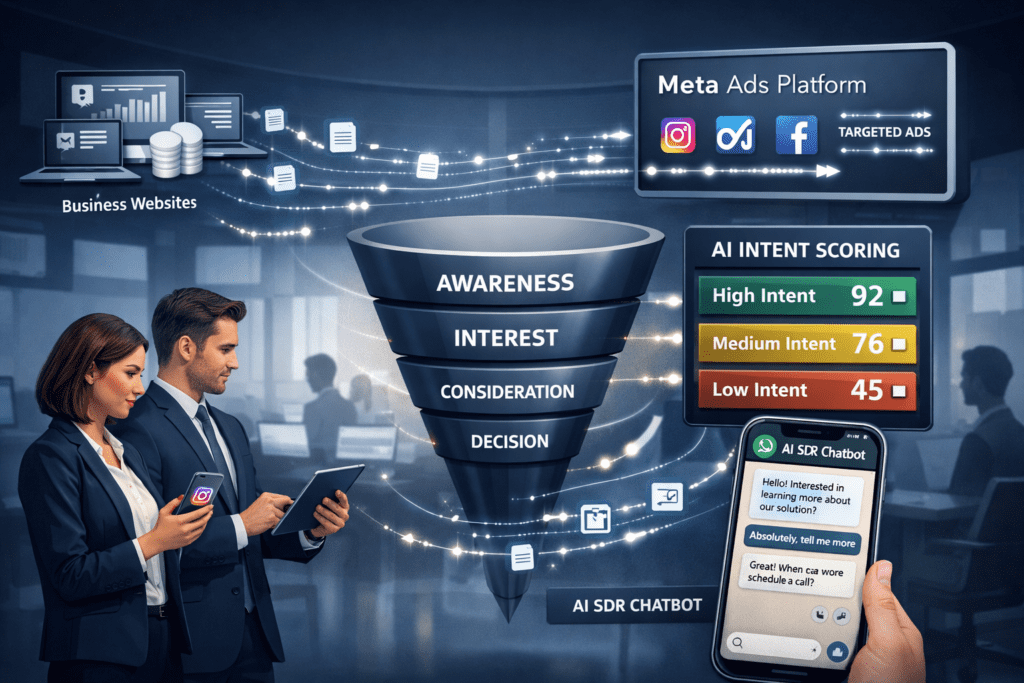
The Facebook/Meta ads updates for 2026 have different implications across industries. Let’s examine how specific sectors are adapting to the new reality. 📈
💼 B2B: The Rise of Intent Scoring and AI Integration
The wall between B2B and B2C has crumbled. B2B decision-makers use Instagram and Facebook, and Meta has built tools to target them.
🎯 Intent Scoring: Platforms like 6sense and Warmly now integrate directly with CAPI. When a target account (e.g., “Microsoft”) shows high intent on a B2B website (visiting pricing pages), that signal is pushed to Meta. Andromeda then up-weights ads to employees of that company across the Meta ecosystem.
🤖 AI Enrichment: B2B Lead Forms on Meta now feature Automated Enrichment. A user enters their work email, and AI fills in the rest (Company Size, Role, Industry) before the lead hits the CRM. This reduces friction (fewer form fields) while maintaining data quality.
💬 AI SDRs: “AI Sales Development Reps” (like Qualified or Drift) are now the first line of defense. When a lead comes in from a Meta ad, an AI agent initiates a WhatsApp or SMS conversation immediately (within seconds), qualifying the lead before a human ever touches it. This speed-to-lead is crucial in 2026.
💬 Conversational Commerce: WhatsApp & Messenger
For Retail and Service businesses, the WhatsApp Business API is the new email marketing.
📱 Full-Funnel Messaging: It’s not just support. Brands send “Authentication” messages (OTPs), “Utility” messages (Shipping updates), and “Marketing” messages (Back in stock alerts).
🛒 Click-to-WhatsApp: Ads that click to WhatsApp are outperforming landing pages for high-consideration purchases. The conversational nature builds trust faster. In 2026, AI chatbots handle the entire transaction—from product selection to payment—within the chat thread.
🎯 Smart Funnels: In Messenger, ads connected to “Smart Funnels” guide users through a diagnostic quiz (“What is your skin type?”) before recommending a product. This interactive pre-sale qualification significantly boosts conversion rates compared to dropping a user on a static collection page.
💰 Section 7: Economic Dynamics and Market Forecast
Understanding the cost landscape is essential for budget planning in light of the Facebook/Meta ads updates for 2026. 💸
📈 Media Inflation Trends
Despite the efficiencies of AI, advertising is getting more expensive. The “Attention Economy” is saturated.
🌍 Global Inflation: Media costs are projected to rise by 4.0% – 4.2% in 2026 according to industry forecasts.
🔥 Regional Hotspots: While the US and Western Europe see moderate inflation (~3-4%), rapidly digitizing markets like Eastern Europe and India are seeing inflation rates of 9-11% due to intense demand from domestic advertisers.
🎥 Format Premium: Video inventory (Reels) is seeing higher inflation (~5%) than static inventory as demand for video outstrips supply.
💵 CPM Benchmarks (2026)
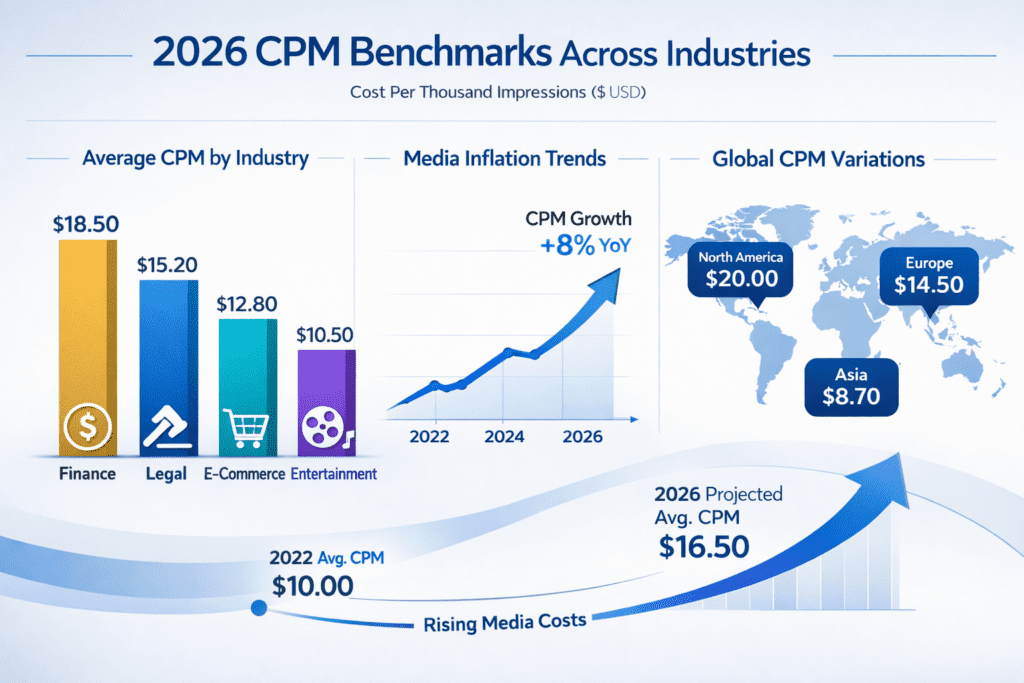
Benchmarks have shifted upward. Advertisers should plan budgets based on these ranges:
| Industry | Average CPM (US) |
|---|---|
| Finance & Insurance | $15.00 – $20.00+ |
| Legal Services | $14.00 – $18.00 |
| E-commerce / Retail | $7.00 – $10.00 |
| Entertainment | $4.00 – $6.00 |
| Global Average | $6.00 – $15.00 |
⚖️ Antitrust Stability
A key stabilizing factor for 2026 was Meta’s victory in the FTC antitrust case regarding the acquisition of Instagram and WhatsApp. The court ruled that TikTok and YouTube are sufficient competitors, negating the monopoly claim.
✅ Strategic Certainty: This means Meta will not be broken up. Advertisers can continue to rely on the cross-platform data sharing between Instagram and Facebook that powers the Lattice algorithm. This integration is now legally secure for the foreseeable future.
🎯 Section 8: The 2026 Strategic Playbook—How to Win
The “Tactical Era” of media buying—day-trading bids, micro-segmenting audiences—is over. The “Strategic Era” is here. Success with the Facebook/Meta ads updates for 2026 requires adhering to three core mandates: Consolidation, Diversity, and Signal Quality. 🏆
🏗️ The “Power of Two” Account Structure
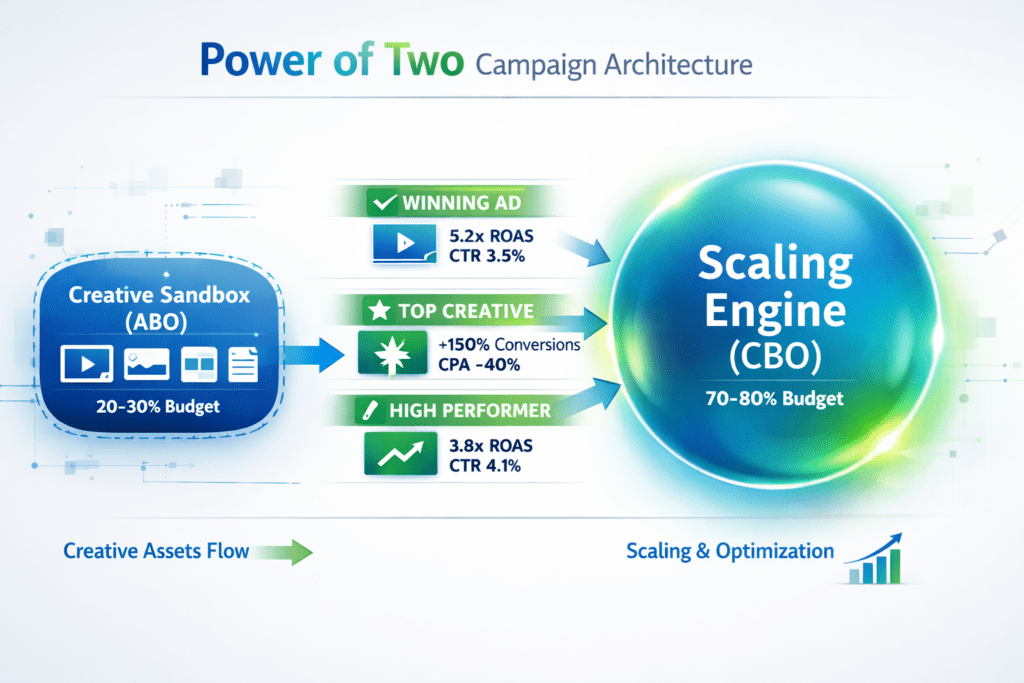
The Andromeda algorithm punishes complexity. It needs data density to learn. Therefore, the optimal account structure in 2026 is radically simple.
📊 The Structure:
Campaign 1: The Scaling Engine (CBO) 🚀
- Objective: Sales / Conversions
- Targeting: Broad (Country-level). No interests. No lookalikes.
- Placements: Advantage+ Placements (All)
- Content: Only validated “Winning” creatives
- Budget: 70-80% of total spend
Campaign 2: The Creative Sandbox (ABO) 🧪
- Objective: Sales / Conversions
- Targeting: Broad
- Structure: One Ad Set per Creative Concept (Archetype)
- Budget: 20-30% of total spend. Used for testing new hooks.
⚡ The Golden Rule: Never test in the Scaling Campaign. Test in the Sandbox. If a creative wins (high ROAS, high spend volume), move its Post ID to the Scaling Campaign. This consolidates social proof (likes/comments) and ensures the Scaling Campaign is never destabilized by bad ads.
🎨 The Creative Diversity KPI
Advertisers must monitor Creative Diversity as strictly as they monitor ROAS. This is one of the most important lessons from the Facebook/Meta ads updates for 2026.
❌ The Problem: If you run 5 ads that all look the same (e.g., 5 UGC videos of a person holding the product), Andromeda treats them as 1 ad. When users get tired of that format, your entire account crashes.
✅ The Solution: You must run Distinct Archetypes simultaneously:
- Archetype 1: Visual ASMR (Satisfying product usage) 🎥
- Archetype 2: Founder Story (Emotional connection) 💭
- Archetype 3: Us vs. Them (Direct comparison / Static image) 📊
- Archetype 4: Benefit Text (Kinetic typography) ✍️
🎯 Why This Works: This allows the algorithm to target different psychological segments of your audience. The person who hates UGC might love the Kinetic Text ad. Diversity lowers your CPMr by increasing your total addressable market.
🔧 Signal Hygiene: The Foundation of Success
Finally, the “pipes” must be clean. Poor data infrastructure will sabotage even the best creative strategy.
✅ CAPI is Non-Negotiable: Ensure your Event Match Quality is >6.0 through proper implementation of the Conversions API.
💰 Feed the Algorithm Value: Don’t just optimize for “Leads.” Optimize for “Qualified Leads” or “Purchases.” Use Offline Conversions to tell Meta which leads actually turned into money.
📊 Incrementality Checks: Once a quarter, run a lift study. Verify that the machine is actually generating new revenue, not just claiming credit for organic traffic.
🎓 Frequently Asked Questions About Facebook/Meta Ads Updates for 2026
Q: Do I still need to set up detailed targeting in 2026?
No. The Facebook/Meta ads updates for 2026 have made detailed targeting largely obsolete. Andromeda performs best with broad, country-level targeting because it can leverage its massive data pool to find your customers more efficiently than manual targeting ever could.
Q: How important is creative testing now?
It’s the single most important factor. With targeting automated, creative is your primary lever for performance. Invest heavily in creative production and testing infrastructure.
Q: Should I still use the Facebook Pixel?
The Pixel should be your backup, not your primary tracking method. Implement CAPI as your main measurement solution. Browser interventions mean pixel-only tracking misses 15-30% of conversions.
Q: What’s the minimum budget to be competitive?
With the Facebook/Meta ads updates for 2026, the minimum effective budget has increased. Plan for at least $1,000-2,000 monthly to give the algorithm enough conversion volume to learn effectively. Below this threshold, the system struggles to optimize.
Q: How do I handle the EU’s “Pay or Consent” model?
Accept that your EU performance will differ from US performance. Invest in contextual creative strategies that work without behavioral targeting. Consider running separate campaigns for EU vs. US with different creative approaches.
🚀 Conclusion: Thriving in the Algorithmic Age
In 2026, the Meta ad platform is a paradox: it is easier than ever to use, but harder than ever to master. The technical barrier to entry has vanished—the machine does the targeting, the bidding, and even the creative design. But the strategic barrier has risen exponentially. 🎯
Winning with the Facebook/Meta ads updates for 2026 requires a fundamental shift in organizational structure—from “Performance Marketing Teams” that tweak bids, to “Creative Performance Teams” that engineer content supply chains.
🏆 The Brands That Will Thrive
The brands that thrive will be those that accept the algorithm as a partner rather than a tool. They will:
✅ Feed it high-quality creative variety through systematic testing frameworks
✅ Trust it with broad targeting instead of micromanaging audience segments
✅ Guide it with robust first-party data via properly implemented CAPI
✅ Invest in AI-powered creative production using tools like GEM
✅ Monitor creative diversity as rigorously as they monitor ROAS
✅ Adapt to regulatory realities in different geographic markets
Those who cling to the manual controls of the past—granular targeting, micromanaged bids, and pixel-only tracking—will find themselves priced out of the auction by the sheer efficiency of Andromeda. 📉
🤖 The Final Word: The machine is awake, and it is hungry for creative. Feed it well.
📚 Additional Resources
Want to dive deeper into the Facebook/Meta ads updates for 2026? Here are essential resources:
- Meta Business Help Center – Official documentation and support
- Meta for Developers – API documentation and technical guides
- Meta Marketing API – Deep dive into programmatic advertising
- Advantage+ Creative – Official guide to AI-powered creative tools
- Conversions API – Server-side tracking implementation
- Digital Markets Act Information – EU regulatory framework
- GDPR Compliance – European privacy regulations
💬 Your Turn: How Are You Adapting?
The Facebook/Meta ads updates for 2026 represent the biggest shift in digital advertising since the introduction of the News Feed algorithm. How is your organization adapting to these changes? What challenges are you facing with creative production, measurement, or regulatory compliance?
Share your experiences and questions in the comments below. The advertising landscape is evolving rapidly, and collective knowledge is our greatest asset. 🌟
📌 Bookmark this guide and revisit it as you implement the Facebook/Meta ads updates for 2026 in your campaigns. The algorithmic revolution is here—are you ready to lead it?
Last Updated: December 26, 2025 | Next Update: March 2026