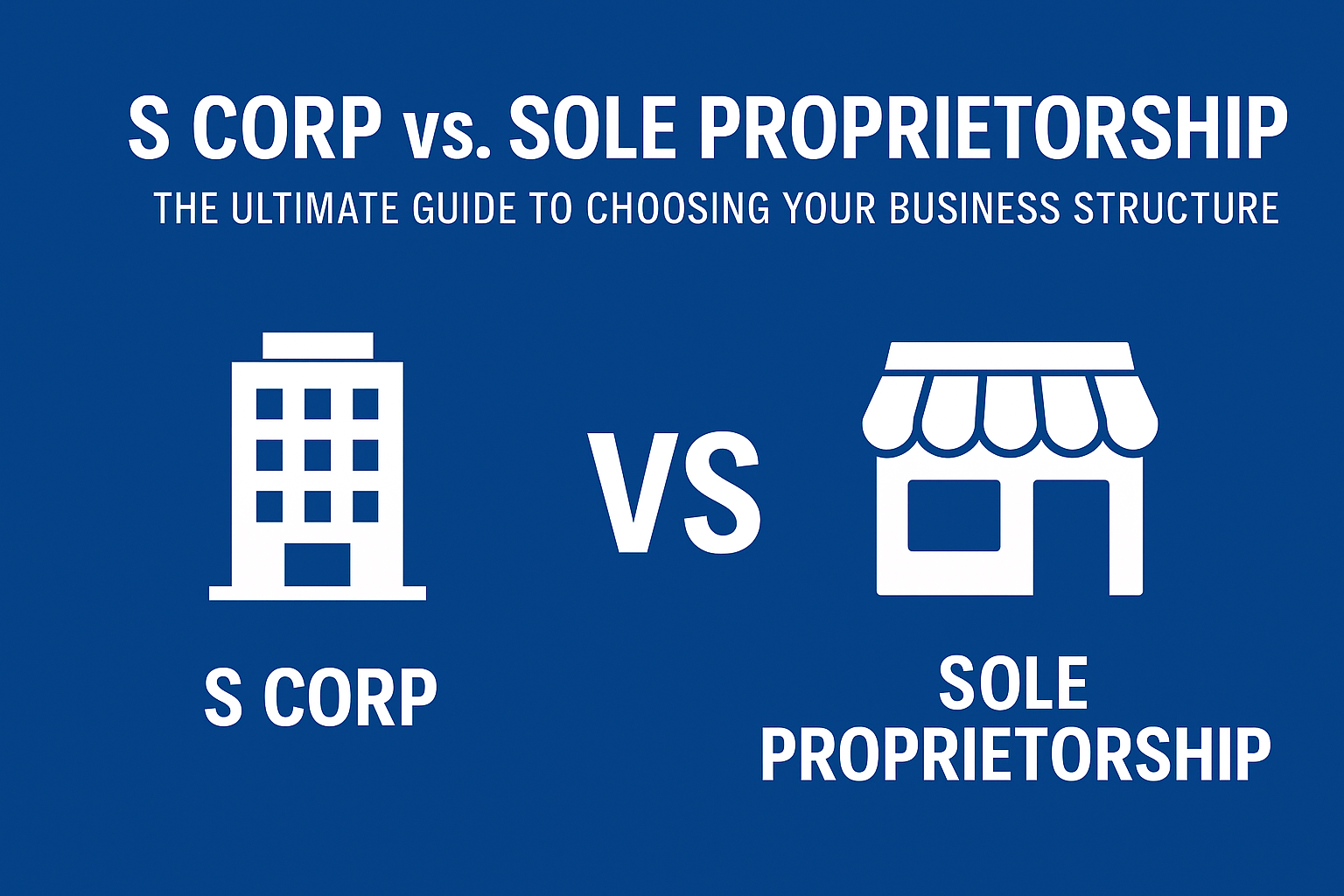
S Corp vs. Sole Proprietorship: The Ultimate Guide to Choosing Your Business Structure 🏢
You’ve launched your business, the clients are coming in, and the revenue is growing. But are your personal assets—your home, your car, your savings—on the line every time you sign a contract? Are you paying more in taxes than you absolutely have to? 💰
Choosing between S Corp vs. Sole Proprietorship is one of the first and most critical strategic decisions an entrepreneur makes. It’s the foundation upon which your financial security, tax obligations, and potential for growth are built. For most new entrepreneurs, the journey begins with a sole proprietorship, the simplest and most common business structure in the United States according to the Small Business Administration. It’s the default setting, often formed automatically without the owner even realizing it.
But as your business matures, a more powerful option emerges in the S Corp vs. Sole Proprietorship debate: the S corporation. This isn’t a different type of company you form, but rather a special tax election that can provide significant liability protection and tax savings as detailed by the IRS guidelines on S Corporations.
The transition from operating as a sole proprietor to electing S corp status often mirrors the evolution of an entrepreneur’s own mindset. It marks the shift from simply doing business as a freelancer or individual to strategically building a durable, separate entity designed for long-term success. This comprehensive guide will serve as your roadmap for navigating the S Corp vs. Sole Proprietorship decision so you can build your business on the right foundation.
At-a-Glance Preview: S Corp vs. Sole Proprietorship 📊
Before diving deep, here is a high-level overview of the core differences in the S Corp vs. Sole Proprietorship comparison:
| Feature | Sole Proprietorship | S Corporation |
|---|---|---|
| Legal Structure | You = The Business | Business is a Separate Entity |
| Personal Liability | Unlimited (Your assets are at risk) | Limited (Personal assets protected) |
| Taxation | Pass-through; All profit subject to Self-Employment Tax | Pass-through; Only salary subject to Payroll Tax |
| Formation | Automatic, no filing required | Formal state filing + IRS election |
| Best For | New, low-risk ventures; testing an idea | Profitable, growing businesses seeking protection & tax savings |
The Sole Proprietorship: Simplicity, Control, and Unfiltered Risk 🎯
The sole proprietorship is the bedrock of American entrepreneurship. According to the Small Business Administration (SBA), a staggering 86.3% of businesses with no employees are structured this way. Its appeal lies in its unparalleled simplicity.
What It Is and How You Become One (The Default Path)
A sole proprietorship is an unincorporated business owned and run by a single individual. Critically, there is no legal distinction between the owner and the business as explained in Nolo’s Business Formation Guide. They are one and the same in the eyes of the law.
This means you don’t have to take any formal action to create one. If you begin conducting business activities—whether it’s freelance writing, consulting, or selling crafts online—and you don’t register as another type of entity, you are automatically a sole proprietor. There is no federal or state paperwork required to bring the entity itself into existence.
If you wish to operate under a business name different from your own legal name (e.g., “Evergreen Web Design” instead of “Jane Doe”), you will typically need to file a “Doing Business As” (DBA) or fictitious name registration with your local or state government as outlined by SCORE’s DBA Guide. This, however, only registers the name; it does not create a separate legal entity.
The Allure of Simplicity: Core Advantages ✨
The primary benefits of a sole proprietorship in the S Corp vs. Sole Proprietorship comparison are its ease and low cost of operation:
Ease of Setup: It is the simplest and least expensive business type to establish and maintain, with minimal legal formalities as confirmed by Investopedia’s Business Structure Guide.
Low Cost: Startup costs are virtually nonexistent. Aside from potential fees for a DBA (typically $10 to $100) and any industry-specific licenses or permits, there are no formation or annual state filing fees.
Total Control: The owner has absolute authority over all business decisions without needing to consult partners or a board of directors.
Simplified Taxes: There is no separate business tax return to file. All business profits and losses are reported directly on the owner’s personal Form 1040 tax return using Schedule C, Profit or Loss from Business.
The Critical Flaw: Unlimited Personal Liability ⚠️
The simplicity of a sole proprietorship comes at a steep price in the S Corp vs. Sole Proprietorship analysis: unlimited personal liability. This is the single most significant drawback of the structure. Because the owner and the business are legally indistinct, all business debts are the owner’s personal debts.
This risk is not abstract; it is tangible and can be financially devastating according to legal experts at LegalZoom:
If your business takes out a loan and cannot repay it, creditors can legally pursue your personal bank accounts and assets to satisfy the debt.
If a customer is injured on your business premises or sues you for professional negligence, and the judgment exceeds your business’s assets, your personal property—your house, car, and family savings—are at risk.
This structure is fundamentally unsuitable for any business with even moderate liability exposure, such as those with a physical storefront, employees, product sales, or those providing professional advice where errors could lead to lawsuits.
Taxation Deep Dive: The Self-Employment Tax Burden 💸
As a sole proprietor in the S Corp vs. Sole Proprietorship tax comparison, your business profits are taxed through a “pass-through” mechanism, meaning they flow directly to your personal tax return. While this avoids a separate corporate tax, it exposes every dollar of profit to the full force of self-employment tax.
Here’s how it works according to IRS Publication 334:
You calculate your business’s net profit on Schedule C (Total Income – Deductible Expenses).
This net profit is then subject to two types of tax:
Regular Income Tax: The profit is added to your other personal income and taxed at your individual federal and state income tax rates.
Self-Employment Tax: This is the crucial part in the S Corp vs. Sole Proprietorship tax discussion. 100% of your net profit is subject to self-employment tax, which is currently set at a rate of 15.3% as detailed in IRS Topic 554. This tax covers both the employer and employee portions of Social Security (12.4%) and Medicare (2.9%).
For example, a sole proprietor with $80,000 in net profit would owe approximately $12,240 in self-employment tax ($80,000 x 15.3%), and this is before calculating a single dollar of federal or state income tax. This heavy tax burden on every dollar of profit is a major financial disadvantage as a business grows.
To mitigate this, sole proprietors can and should deduct all legitimate business expenses, such as:
- Home office expenses (see IRS Publication 587)
- Business use of a vehicle and mileage (per IRS Publication 463)
- Health insurance premiums (detailed in IRS Topic 502)
- Business supplies, software, and professional services
The S Corporation: A Strategic Shield for Protection and Profit 🛡️
As a business achieves consistent profitability and its owner’s personal assets grow, the risks and tax inefficiencies of the sole proprietorship become untenable in the S Corp vs. Sole Proprietorship evaluation. This is the moment to consider a strategic upgrade to an S corporation.
Demystifying the S Corp: A Tax Election, Not a Legal Entity
It is essential to understand in the S Corp vs. Sole Proprietorship comparison that an S corporation is not a type of business entity you can form with your state government. It is a tax status that you elect with the Internal Revenue Service (IRS) as explained in IRS Instructions for Form 2553.
The process involves two fundamental steps:
Form a Legal Entity: First, you must create a formal business entity with your state. This is typically a Limited Liability Company (LLC) or a traditional C Corporation. This act creates the legal separation between you and your business as detailed by Harvard Business Services.
Elect S Corp Status: After your LLC or corporation is formed, you file Form 2553, Election by a Small Business Corporation, with the IRS. If approved, the IRS will tax your business under Subchapter S of the Internal Revenue Code, granting you S corp status.
The Premier Advantage: The Corporate Veil of Liability Protection 🏰
By first forming an LLC or corporation in the S Corp vs. Sole Proprietorship structure decision, you create a separate legal entity. This separation establishes a protective barrier known as the “corporate veil” between your business’s finances and your personal finances as explained by Cornell Law School.
This means that if your business incurs debts or is sued, creditors and litigants can generally only pursue the assets owned by the business itself. Your personal assets—your home, savings, and investments—are shielded from liability.
However, this protection is not absolute according to legal experts at Justia. A court can “pierce the corporate veil” and hold an owner personally liable under certain circumstances, such as:
Commingling Funds: Mixing personal and business finances in the same bank account.
Fraud or Illegal Acts: Engaging in fraudulent activity through the business.
Failure to Follow Corporate Formalities: Not holding required meetings, keeping minutes, or maintaining proper business records.
Personal Guarantees: If you personally guarantee a business loan, you are personally liable for that debt regardless of the business structure.
The Tax-Saving Engine: Salary vs. Distributions 🚀
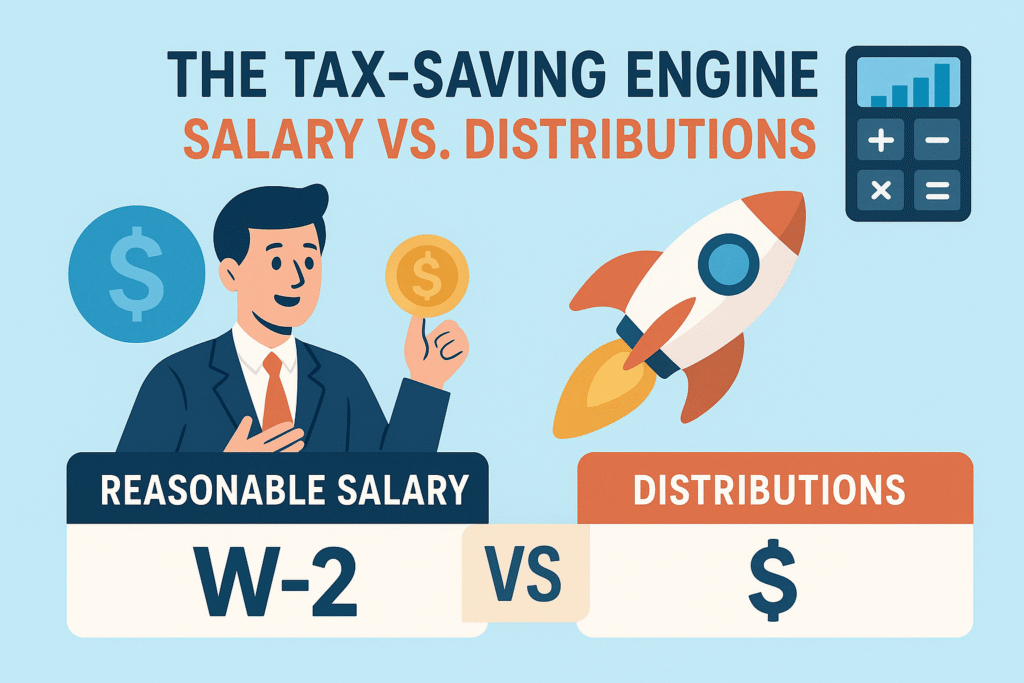
The primary financial incentive for electing S corp status in the S Corp vs. Sole Proprietorship tax analysis lies in its unique approach to owner compensation, which can dramatically reduce the self-employment tax burden. An owner who works in the business is treated as an employee and is paid in two ways according to IRS guidance on S Corporation compensation:
A Reasonable Salary: The owner must be paid a “reasonable salary” via a formal payroll system (like any other employee) for the services they provide. This W-2 salary is subject to FICA payroll taxes (15.3% for Social Security and Medicare), with the business paying half (7.65%) and the employee-owner paying the other half (7.65%) through withholding.
Distributions: Any remaining profits in the business can be paid out to the owner as distributions (similar to dividends). These distributions are NOT subject to FICA or self-employment taxes.
The IRS requires that the salary paid to an owner-employee be “reasonable” for the work performed, based on factors like industry, experience, and responsibilities as detailed in Treasury Regulation 1.162-7. The agency scrutinizes this closely to prevent business owners from paying themselves an artificially low salary to avoid payroll taxes.
This requirement to set a formal, reasonable salary does more than just satisfy the IRS; it instills a crucial financial discipline. While a sole proprietor might informally draw money from the business account as needed, an S corp owner in the S Corp vs. Sole Proprietorship framework is forced to quantify their value as an employee. This act cleanly separates the owner’s compensation (an operating expense) from the business’s true net profit (the return on capital and entrepreneurship). This leads to cleaner financial statements, a more accurate understanding of profitability, and a stronger foundation for future valuation, loans, or investment.
Formation and Ongoing Compliance: The Cost of Protection 📋
The benefits of an S corp in the S Corp vs. Sole Proprietorship decision come with increased complexity and cost.
Step-by-Step Formation Process:
- Form an LLC or C-Corp: File Articles of Organization (for an LLC) or Articles of Incorporation (for a C-Corp) with your state’s Secretary of State. Filing fees vary widely by state, typically ranging from $50 to $500 according to BizFilings’ State Filing Fee Guide.
- Obtain an EIN: Apply for an Employer Identification Number (EIN) from the IRS using Form SS-4. This is free and can be done online at IRS.gov.
- File Form 2553: Complete and file the S corp election form with the IRS. This must be done within a specific timeframe: no more than 2 months and 15 days after the beginning of the tax year for the election to be effective for that year as specified in IRS Form 2553 Instructions.
Annual Compliance Checklist:
- Run Payroll: Formally process payroll for the owner’s salary and any other employees, including withholding and paying payroll taxes
- File Payroll Tax Returns: Submit quarterly Form 941s and annual Form 940 to the IRS
- Maintain Corporate Formalities: Hold and document annual shareholder meetings, even if you are the only shareholder
- File Business Tax Return: File an annual S corporation tax return, Form 1120-S, and provide a Schedule K-1 to each shareholder detailing their share of the company’s income, deductions, and credits
- Pay State Fees: Pay any required state annual report fees or franchise taxes. For example, California imposes an $800 minimum annual franchise tax on all S corporations per California Franchise Tax Board
Head-to-Head Comparison: A Feature-by-Feature Breakdown 🥊
To make the S Corp vs. Sole Proprietorship decision clearer, this table provides a direct comparison of the most important features. It distills the key differences into a single, scannable resource that highlights the trade-offs between simplicity and strategic advantage.
The Ultimate S Corp vs. Sole Proprietorship Showdown
| Feature | Sole Proprietorship | S Corporation | Key Insight |
|---|---|---|---|
| Owner Liability | Unlimited. Personal assets are fully exposed to business debts and lawsuits. | Limited. Personal assets are generally protected by the “corporate veil”. | Protection is the primary non-tax driver for choosing an S corp in the S Corp vs. Sole Proprietorship decision. |
| Taxation Method | Pass-through to personal return (Schedule C). No separate business return. | Pass-through to personal returns (Schedule K-1). Requires separate business return (Form 1120-S). | S corp adds an administrative layer but unlocks strategic tax planning in S Corp vs. Sole Proprietorship comparison. |
| Self-Employment / FICA Tax | 15.3% tax on 100% of net profits. | 15.3% FICA tax on reasonable salary ONLY. Distributions are exempt. | This is the source of major tax savings for profitable businesses in S Corp vs. Sole Proprietorship analysis. |
| Formation Process | Automatic. No formal action required. Can file a DBA for a trade name. | Multi-step. Must form an LLC/Corp with the state, then file Form 2553 with the IRS. | The upfront effort of an S corp is an investment in future protection and savings. |
| Formation & Annual Costs | Minimal. ~$10-$100 for a DBA. No required annual state fees. | Moderate. State filing fees ($50-$500), potential annual report fees, and possible state franchise tax (e.g., $800 in CA). | The ongoing costs of an S corp must be outweighed by the tax savings and liability protection. |
| Administrative Burden | Low. Minimal record-keeping required. No formal meetings. | High. Requires payroll, corporate formalities (meetings, minutes), and separate bookkeeping. | The simplicity of a sole proprietorship is traded for the robust (but demanding) structure of an S corp. |
| Raising Capital | Difficult. Cannot sell stock. Banks may be hesitant to lend. | Easier. Enhanced credibility. Can sell stock to up to 100 eligible shareholders. | S corp structure signals stability and is more attractive to investors and lenders. |
| Ownership Transfer | Difficult. Business ends if owner stops. To sell, you sell assets individually. | Simple. Ownership is transferred by selling stock. Business has a perpetual existence. | S corps are built for continuity and succession planning. |
The Decision Framework: Which Structure is Right for You? 🤔
The choice in the S Corp vs. Sole Proprietorship decision is not about which is universally “better,” but which is strategically right for your business at its current stage and for its future goals.
The Income Inflection Point: When an S Corp Saves You Money 💡
From a purely financial perspective, the S Corp vs. Sole Proprietorship decision often hinges on a simple question: Will the tax savings from an S corp outweigh its additional administrative costs?
Generally, the S corp election becomes financially beneficial once your business’s annual net profit consistently reaches the $40,000 to $50,000 range according to tax experts at TurboTax. Below this threshold, the costs of payroll services, accounting, and state fees, combined with the payroll taxes on a reasonable salary, can easily erase any potential savings on distributions.
Real-World Scenarios & Case Studies 📖
Let’s apply the S Corp vs. Sole Proprietorship framework to three common entrepreneurial paths:
Scenario 1: The Freelance Photographer (Ideal for Sole Proprietorship) 📸
Profile: Sarah is in her first year of business. She projects a net profit of around $35,000. She works from her home office, has no employees, and her primary risk is equipment damage, which is covered by insurance.
Why Sole Prop Wins in S Corp vs. Sole Proprietorship: The simplicity and near-zero cost are perfect for her current stage. The potential tax savings from an S corp would be negligible and likely consumed by the costs of payroll and accounting. Her liability risk is low and can be effectively managed with a good business insurance policy from providers like NEXT Insurance or Hiscox.
Scenario 2: The Growing Marketing Agency (Prime for S Corp Transition) 📈
Profile: David, a marketing consultant, has been operating as a sole proprietor for three years. His net profit last year was $120,000. He wants to hire a virtual assistant and feels that a more formal business structure would enhance his credibility when pitching larger corporate clients.
Why S Corp Wins in S Corp vs. Sole Proprietorship: The tax savings are substantial. By setting a reasonable salary of $70,000 and taking the remaining $50,000 as a distribution, he could save over $7,650 in self-employment taxes annually. The formal structure adds the credibility he seeks and provides a legal framework for hiring. Most importantly, it protects his growing personal assets from business liability.
Scenario 3: The Local Coffee Shop (S Corp from Day One) ☕
Profile: Maria is opening a brick-and-mortar coffee shop. She will have employees, a commercial lease, inventory, and hundreds of customers visiting daily.
Why S Corp is Essential in S Corp vs. Sole Proprietorship: Operating as a sole proprietorship is not a viable option. The risk of unlimited personal liability is far too high. A single slip-and-fall lawsuit could jeopardize Maria’s personal savings and home. By forming an LLC and electing S corp status from the beginning, she establishes an essential liability shield from the moment she opens her doors.
Your Decision-Making Checklist ✅
Answer these questions to clarify which path is right in your S Corp vs. Sole Proprietorship decision:
- Is your projected annual net profit consistently above $40,000?
- Do you have significant personal assets (a home, savings, investments) that you need to protect?
- Does your business operate in an industry with a moderate to high risk of liability (e.g., has a physical location, employees, sells products, provides professional advice)?
- Do you plan to seek investment, apply for significant business loans, or eventually sell your business?
- Are you prepared to handle the administrative duties of a corporation, including running payroll, holding meetings, and maintaining separate, detailed financial records?
Your Next Steps: From Decision to Action 🚀
Once you have clarity on the right structure in the S Corp vs. Sole Proprietorship comparison, it’s time to act.
Staying a Sole Proprietor? Best Practices
If the sole proprietorship is the right fit for now in your S Corp vs. Sole Proprietorship analysis, take these steps to operate more professionally and protect yourself:
Open a Separate Business Bank Account: This is the most important step. Never commingle business and personal funds. It simplifies bookkeeping and demonstrates a clear separation for tax purposes. Consider business accounts from Chase Business Banking, Bank of America Business, or Capital One Business.
Obtain Necessary Licenses and Permits: Ensure you have all required local, state, and federal permits to operate legally. Use the SBA’s License & Permits Tool to identify requirements.
Get Business Insurance: Consult with an insurance broker to secure adequate general liability and, if applicable, professional liability (errors and omissions) insurance. Research options through Insureon or Progressive Commercial.
Making the Leap to an S Corp: A 4-Step Action Plan
If you’re ready for the protection and tax benefits of an S corp in the S Corp vs. Sole Proprietorship decision, follow this plan:
- Consult the Professionals: Your first call should be to a Certified Public Accountant (CPA) and a business attorney. They can analyze your specific financial situation and confirm that an S corp is the optimal choice in your S Corp vs. Sole Proprietorship evaluation, helping you determine a reasonable salary. Find CPAs through the American Institute of CPAs Directory.
- Form Your Legal Entity: Work with your attorney or use a reputable online service like LegalZoom, IncFile, or Northwest Registered Agent to file the necessary paperwork (Articles of Organization or Incorporation) with your state’s Secretary of State to form your LLC or C Corporation.
- Get Your EIN: Once your entity is approved by the state, apply for your free Employer Identification Number (EIN) directly from the IRS website.
- File Form 2553: Complete and file IRS Form 2553 to elect S corporation tax status. Pay close attention to the filing deadlines to ensure your election is effective for the desired tax year.
Conclusion: Making the Right Choice in S Corp vs. Sole Proprietorship 🎯
Choosing your business structure in the S Corp vs. Sole Proprietorship decision is a dynamic choice, not a permanent one. A sole proprietorship is the perfect launchpad for many ventures, offering simplicity when you need it most. But as your business grows, the S corporation stands ready as a powerful vehicle for protecting your personal wealth and optimizing your tax strategy in the S Corp vs. Sole Proprietorship analysis.
The key is to be proactive. Review your business structure annually with your accountant as your profits and risks evolve. Don’t leave your financial future to the default setting in the S Corp vs. Sole Proprietorship comparison. Take control, make a strategic choice, and build your business on a foundation designed for lasting success.
For more guidance on the S Corp vs. Sole Proprietorship decision and choosing the right structure, visit the SBA’s comprehensive business structure guide, consult with tax professionals, and consider resources from the IRS Small Business and Self-Employed Tax Center.
Remember, the S Corp vs. Sole Proprietorship decision is ultimately about protecting your future and maximizing your business’s potential. Choose wisely, and your business structure will serve as the solid foundation for years of entrepreneurial success! 🌟
Disclaimer: This article is for informational purposes only and should not be considered legal or tax advice. The S Corp vs. Sole Proprietorship decision involves complex factors that vary by individual circumstances. Always consult with qualified legal and tax professionals before making business structure decisions.